




Messi Vs KDB: Who’s A Better Passer Of The Ball?
The footballing world never lacks subjects for debate or contestation. This is more so, because players’ performances or achievements are now assessed using statistics. Season in, season out, new metrics are formulated particularly to serve as yardsticks for comparing players.
Some pundits are averse to this method of assessing players’ abilities. They believe raw talents now take backseat in the assessment of players and needless statistics are projected and celebrated to drive home points in a battle of supremacy.While this may not be completely true the reality is that nowadays, we argue over the best header of the ball, the best set piece taker, the best dribbler, the best assister, it has gotten so ridiculous that the best pre-assister is often considered. What of the most skillful player, even when sometimes we mistake flamboyant and unrewarding showboating for skilful handling of the ball?
Scoring goals, which is a collective team work as no player can move the ball from his own half to the opponents’ and put it in the back of the net, is now seen as a solo effort. Therefore, we talk of the highest goal scorer, the player with the highest number of hat tricks, the ratio of match to goal etc.
These metrics were cited frequently for the almost fifteen years when the duo of Messi and Ronaldo dominated the world of football. They were cited by their fans in what has been termed the GOAT debate. However, since the two players have reached the twilight of their careers, football enthusiasts have shifted their focus to players in their prime. Mbappe/Haaland, Yamal/Palmer, etc.
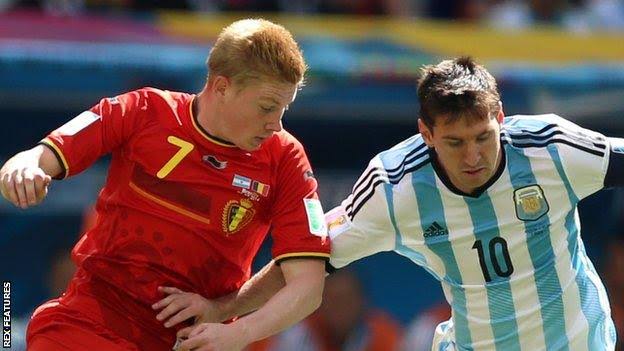
However, recently another debate “erupted” like a volcano threatening to engulf the cyberspace. For a couple of weeks football lovers argued over who’s a better passer of the ball between the diminutive argentine genius, Lionel Messi and Belgian midfield maestro, Kevin Debruyne.
While we may not give you a straightforrward or conclusive answer. Here are the points to consider in this debate.
1. Position: Debruyne is a natural midfielder. To be specific he is an attacking or central midfielder. He is one of the best players to have ever played in that position. While Debruyne’s years at the Stamford Bridge with the Chelsea Football Club weren’t spectacular, he showed the stuff he was made of at the Ethiad Stadium in his decade-long time with the Manchester City after his stint at the Bundesliga with Wolfsburg.He was the engine room of the Manchester City while his time lasted.Debruyne holds the premier league record of the fastest player to reach 100 assists.The Belgian distinguished himself as a excellent passer of the ball by surpassing Cesc Fabregas’ the previous holder of the record. Debruyne has over 300 assists in 700 career games for clubs and country. Debruyne knows his onions and never hides his joy in creating opportunities for other players to score goals.
“When you score it’s a great feeling but to give a great pass means it’s something special for me. It’s very under-rated what we do,” he continued.
“Sometimes you just square the ball and somebody else shoots, but some assists are so nice and the passing is very important.” Kevin De Bruyne said while emphasizing the symbiotic relationship that leads to victory in a game of football.
Lionel Messi is, however, a natural forward who operates from the right flank. The Argentine is, however, so versatile that he has played so many roles in a career spanning two decades. He has played as a “false nine” several times particularly under Pep Guardiola who purposely created the role for him to suit his game plans and catch opponents unawares. “La pulga” as he is popularly known has also played as a mildfielder. Reason many believe he is so amorphous to be defined, calling him a “free role” player for want of better term.
Messi has 456 assists in over 1000 games. This is the highest assists in the history of football. Meanwhile, Debruyne’s lesser career assists were achieved in a lesser game. This simply means the Belgian has a better assists to game ratio than Messi.
Playmaking Ability: This is also another controversial term. Some lovers of the game even consider nebulous the difference between assisting and playmaking. This is not completely true. A true playmaker controls the tempo of the game. He is a conductor who leads a wonderful orchestra. A playmaker holds the ball, dictates the pace, flow and direction of the game. He has an argus-eyed vision. It takes exceptional coordinating skills and ability to link defence with attack to be a legendary playmaker. In this regard, Messi holds the record as the best playmaker in history having won 5 IFFHS awards in his career while Debruyne has won 3 falling behind Messi’s former Barcelona teammate, Xavi Hernandez who won 4 in his playing years.
Shared Qualities of Both Players: Both Leo and Debruyne possess the ability to give curling, well-weighted, defence-splitting passes that a good striker can’t afford to waste. While Messi can run with ball, covering many metres without losing the round leather to the opponents before delivering a lethal pass to a teammate, Debruyne can literally “conjure up” a magical pass from a distance.